Why does your brand exist? And why does it do what it does? Whatever your answer is, get clear on it. Because if you’re trying to make an impact, your brand likely exists for a reason that goes way beyond making money. And the better you can articulate that reason, the more likely it is you’ll turn heads and stop people in their tracks.
Here’s the deal:
Consumers may buy products, but they buy into your beliefs. This is why you need to be clear on what you stand for, what you’re fighting for, and why people should care. And with a killer brand purpose statement, you’ll get the corporate version of Polaris, guiding every decision from product development to partnerships.
Most brands totally botch this. Will you?
You don’t have to if you follow our guide to writing your own brand purpose statement. Bust out your pen, paper, and vision — class is in session!

What Is a Brand Purpose Statement? (And Why Everyone Gets It Wrong)
First things first — what’s a brand purpose statement and why can’t you just ChatGPT your way to one? Let’s kick things off with what it isn’t.
A brand purpose statement is not your mission (what you do) or your vision (where you’re going). What it is is your answer to “what gets you out of bed every day?”
Imagine asking this same question to a brand like Patagonia. Patagonia would say something along the lines of:
“We’re in business to save our home planet.”
Or what about The Body Shop? The brand would tell you that it “fights for a fairer, more beautiful world.”
Compare these to generic corporate speak, such as ‘delivering innovative solutions to create value for stakeholders.’
Do you see the difference? One inspires action. But the other is likely to trigger your BS detector.
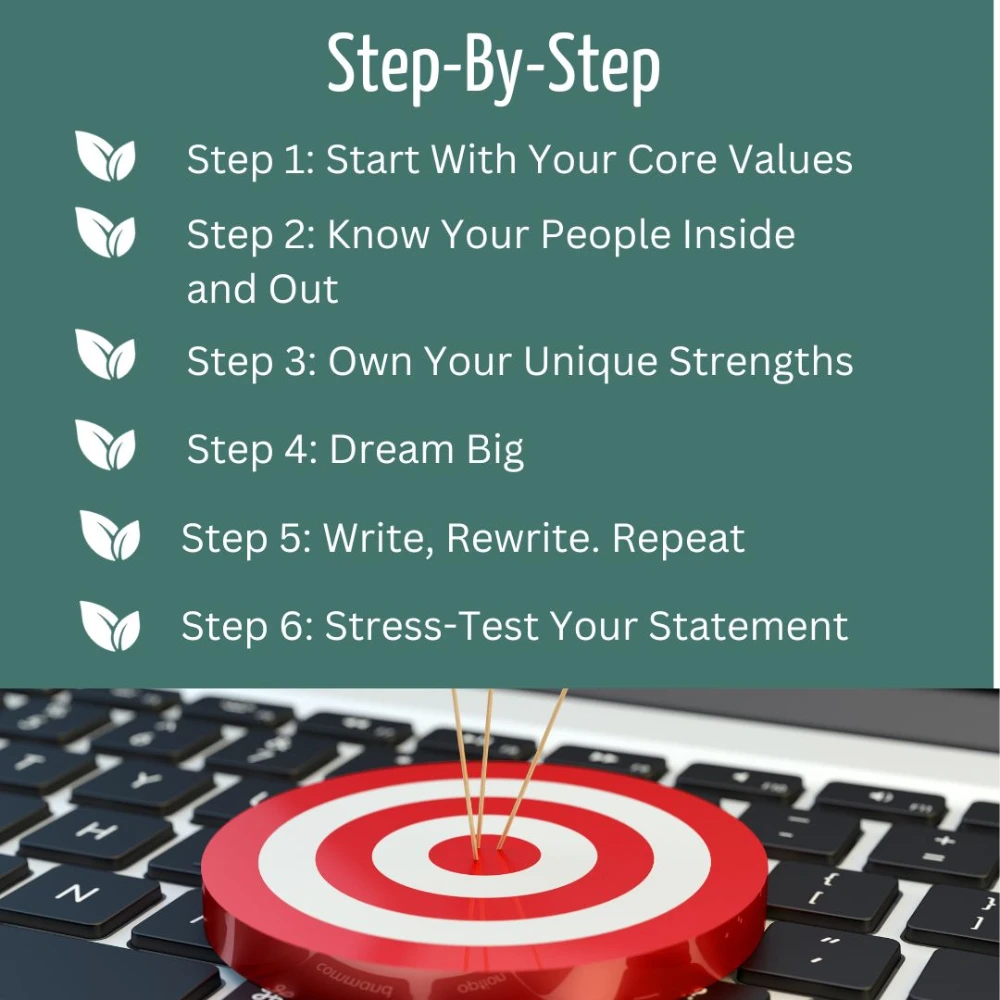
Step 1: Start With Your Core Values (No BS Allowed)
Before you can tell the world what you stand for, you need to know what you actually do stand for.
And by that, we don’t mean what sounds good in a boardroom. Rather, your brand purpose statement should be what’s genuinely non-negotiable for your brand.
Ask yourself:
- What principles guide our brand’s toughest decisions?
- What would we never compromise on, even if it costs us money?
- What gets our team fired up and ready for round 2?
Workshop it and get your team together for a no-filter brainstorming sesh. Whatever values keep coming up are your foundation.
Step 2: Know Your People Inside and Out
Your brand purpose statement is as much for your audience as it is for your agendas.
So, once you’ve finished your brainstorming session, dig deep into your audience. Ask:
- What keeps them up at night?
- What are they trying to be for themselves and their communities?
- What kind of world do they want to build?
For instance, if you’re targeting eco-conscious consumers, they’re probably anxious about the environment by a factor of ten — all while desperately wanting to make a positive impact.
To reach this audience, your purpose should speak to that tension and offer a path forward.
Step 3: Own Your Unique Strengths
There’s always some brand claiming that it “follows ethical business practices” or “gets its beans from Fair Trade-certified sources only.”
So, if you want to stand out, lean into how you do things, why you started, or what you bring to the table that nobody else can — and not WHAT you do.
Maybe you’re the only B Corp in your space.
Or perhaps you’re a founder who survived something that changed your worldview.
Have you cracked a sustainability challenge others can’t solve?
Whatever applies to you, that’s your secret sauce.
To see what you bring to the table, you should be brutally honest with yourself with a SWOT analysis. Your unique strengths are hiding in there, waiting to become the backbone of your brand purpose statement.
Step 4: Dream Big (But Stay Real)
Yes, your brand purpose statement should be aspirational, but there’s a fine line between “aspirational” and “delusional.”
To avoid crossing that line and wearing the delulu dunce cap, mention the dent you want to make in the universe and make sure it connects to what you do.
Ask yourself:
- What would success look like beyond revenue growth?
- What legacy do we want to leave?
- How do we want the world to be different because we exist?
Your answers should be in line with your values and your audience’s needs. Is there a disconnect? If so, keep digging, amigo.
Step 5: Write, Rewrite. Repeat (If Necessary)
And now comes the fun part: turning your insights into a statement that actually works.
Do you need something to follow? Try this template to start:
“[Brand] exists to [do what] for [whom] by [how], so that [impact].”
Whatever you fill the blanks with, keep it:
- Simple: If your grandma can’t understand it, it’s too complex
- Specific: Avoid buzzwords like “innovative solutions”
- Authentic: It should sound like you, not a consultant
It’s not going to look like the Mona Lisa the first time. Write multiple versions and share them with your team, your biggest fans, and even some customers.
Finding the right one is like putting on a tailored suit — you’ll know immediately if it’s the right fit.
Step 6: Stress-Test Your Statement
What’s the point of investing so much time into a killer brand purpose statement if it’s doomed to collect dust later? You need to put it to the test, and to do that, you should see if it can:
- Help you make tough choices
- Get your team on board
- Influence what your brand does day to day
- Put you in a class different from your competitors
If you can’t answer “yes” to all of these, go back to the drawing board (or board room).
Brands Getting Purpose Right
Patagonia
The sustainable apparel brand’s purpose statement is:
“We’re in business to save our home planet.”
And as you may have heard, Patagonia talks and walks a big game by suing the government, donating profits, and telling people not to buy their products unless they need them.
Whole Foods
The Austin-based healthy food giant aims “to nourish people and the planet” — and it shows!
Every decision, from what you see on the shelves to the store designs, connects back to nourishment.
Starbucks
When Starbucks “inspires and nurtures the human spirit — one person, one cup, and one neighborhood at a time,” it means it. Do you notice how the brand connects its product (coffee) to human connection?
Think of this the next time you get a cup of Fair Trade Joe from that barista who knows everybody’s names.
Don’t Fall into These Traps
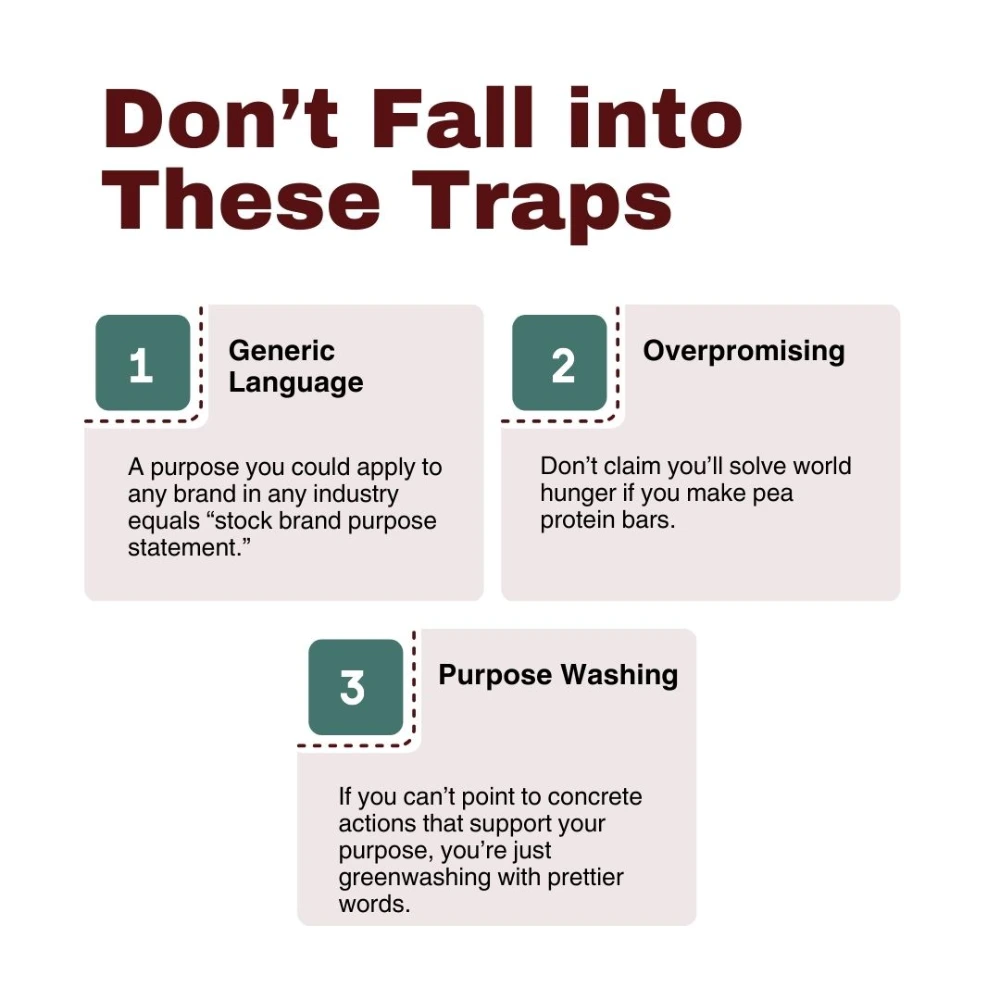
So, you now know how to craft your brand purpose statement. Here’s what NOT to do:
- Generic Language: A purpose you could apply to any brand in any industry equals “stock brand purpose statement.”
- Overpromising: Don’t claim you’ll solve world hunger if you make pea protein bars.
- Purpose Washing: If you can’t point to concrete actions that support your purpose, you’re just greenwashing with prettier words.
Make Your Purpose Your Superpower
More than marketing copy, a compelling brand purpose statement attracts the right customers, inspires your team, and guides every decision you make.
Your purpose is already there, waiting to be uncovered and articulated. All you need is the right approach (and team) to help you give it the voice it deserves.
Are you ready to uncover and articulate your brand’s true purpose? Aliste Marketing partners with purpose-driven brands to craft statements that inspire action and drive real impact.
Contact us today to start your purpose-driven journey.