The question for 2027 is not going to be, “How do we do everything?”
When I was first asked to talk about the marketing trends that would matter in 2027, I hesitated.
I am naturally skeptical of anyone who claims they can predict exactly what marketers will be doing a year from now. Marketing moves too quickly for that, and the people telling you that they know exactly which platform, tactic, or algorithm will matter next usually have something to sell you.
Still, there was a question I could not shake.
What if we stopped trying to predict the next shiny thing and paid attention to what marketers are already telling us?
So that is what I did.
I took out a pencil and a notebook, which felt almost rebellious at this point, and started writing down what I was hearing from senior marketing leaders inside The Momentum Exchange, in client conversations, at events, and in the many informal conversations I have with people who are trying to figure out what marketing should actually look like next.
Then I used AI to help me research the data behind those observations.
That order mattered to me, to push the thinking to come first and the tool second.
Bringing That Research To Life
That became the foundation of our recent Momentum Exchange conversation about 2027 marketing trends, and almost immediately, the room proved the point of the presentation.
People were not quietly sitting through slides. They were reacting, sharing their own experiences, challenging ideas, and building on what they were hearing live in the chat.
When we talked about how aggressively consumers are tuning out advertising, one person shared that she had stopped listening to a podcast she liked because it had too many ads. Another said he skips straight past sponsor segments on YouTube while someone else said she specifically pays attention to the brands that are trying to sound more human.
The conversation was already moving before we had even gotten to the first major trend. That was fitting, because one of the biggest conclusions from the research was simple.
More is not the answer.
We have more tools than ever, and that is exactly the problem
Marketers have never had more capability.
We can build a landing page in an afternoon, create a website over a weekend, and generate dozens of content ideas in seconds. We can automate workflows, draft campaigns, analyze data, and move faster than teams could have imagined even a few years ago! That sounds like an advantage because it is one but the problem is that everyone else has the same advantage.
“When everyone has access to the same tools, it becomes much easier for everyone to sound the same.”
At the same time, consumers are getting remarkably good at ignoring us. In the research I shared during the session, 81 percent of U.S. consumers reported actively trying to avoid advertising. They are paying for ad-free subscriptions, using blockers, and skipping messages before brands have a chance to make their point.
“We should probably stop doing things that people are ignoring.”
That line got a reaction because everyone in the room knew exactly what I meant.
We keep getting asked to add another campaign, another platform, another format, and another tactic, while the people on the other side are working harder to avoid all of it.
At some point, that equation stops making sense.
More is not the answer.
The question for 2027 is not going to be, “How do we do everything?”
t is going to be, “What are we making, who are we making it for, where does it need to show up, and why should anybody give a shit about what we are talking about?” That is a much harder question and also a much more useful one.
The shift from audience to belonging
One of the strongest themes in the room was the difference between building an audience and building a community.
For years, marketers were taught to chase reach.
We counted followers, subscribers, impressions, and likes. We were constantly asking people to follow us somewhere else, join another list, or pay attention to another channel.
Those numbers are not meaningless, but they are not the same thing as belonging.
I said during the presentation, “An audience sits back and watches what you are building, but a community recognizes themselves as part of your brand.”
That distinction matters because people behave differently when they feel like they belong.
They recommend it, participate, and introduce other people and they defend the brand while contributing. I would rather have a smaller group of people who genuinely care about what a brand is doing than a massive following where nobody talks, participates, or pays attention.
The chat immediately reinforced this.
One member talked about how much she values trusted communities and relationships. Another said she belongs to several professional communities because she gains opportunities and contributes her own expertise in return, while others shared how very selective about the communities they joined and that they love being part of The Momentum Exchange.
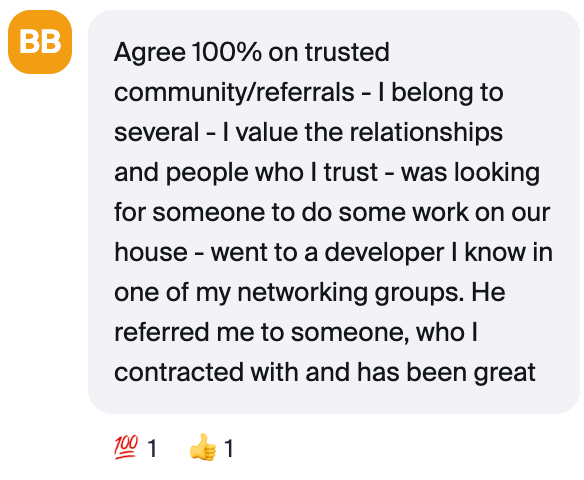
That is the difference we are fueling, a real community is not an audience waiting for you to publish something but rather a group of people who see value in one another.
That led to another question I asked the room:
Whose world do we have permission to enter?
Instead of thinking about your customer as a target, think about that person as someone who already has a life.
They already trust certain people, belong to communities, spend time in certain places and already follow brands that reflect something about who they are.
So the smarter question is not, “How do we interrupt them?”
It is, “Where do we naturally belong in their world?” That is where collaboration becomes much more interesting.
Collaboration gets stronger when the audiences overlap
We talked about examples like Hallmark and the NFL, Stanley and Starbucks, and brands that have successfully brought two loyal communities together.
The important part is not the size of those companies but the logic behind the partnership.
- They share an audience without necessarily competing for the same sale.
That is something almost any business can explore.
During the session, I talked about drawing a simple Venn diagram with The Momentum Exchange on one side and another community on the other. The goal was to identify where the audiences overlap and where there could be mutual value.
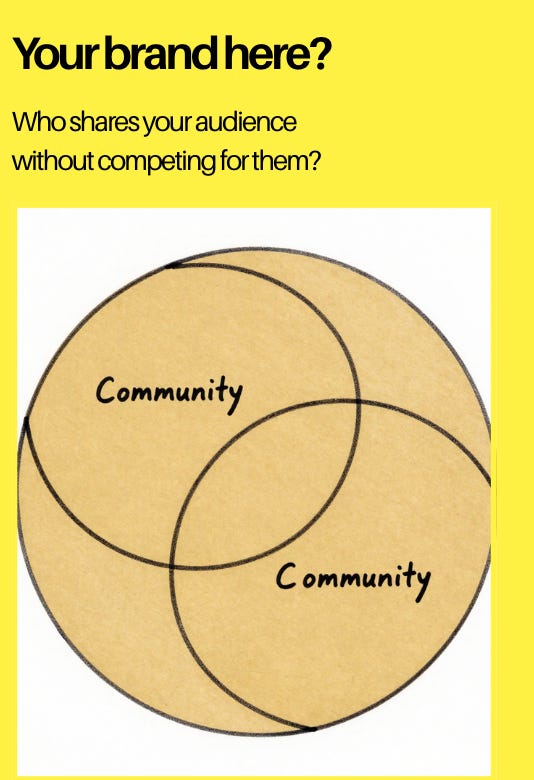
That is often where the opportunity is hiding.
Later in the Q&A, one member shared that he was already writing an outreach note while we were still talking because the idea had helped him see exactly what he wanted to say!
That was one of my favorite moments of the session. He was not taking notes so he could think about it six months from now, he was using the conversation while it was happening.
I told him that half the battle is often getting out of our own heads and making the ask. You do not need to know exactly what the partnership will look like before you begin the conversation. Sometimes you just need to start it.
The brand experience is becoming as important as the product
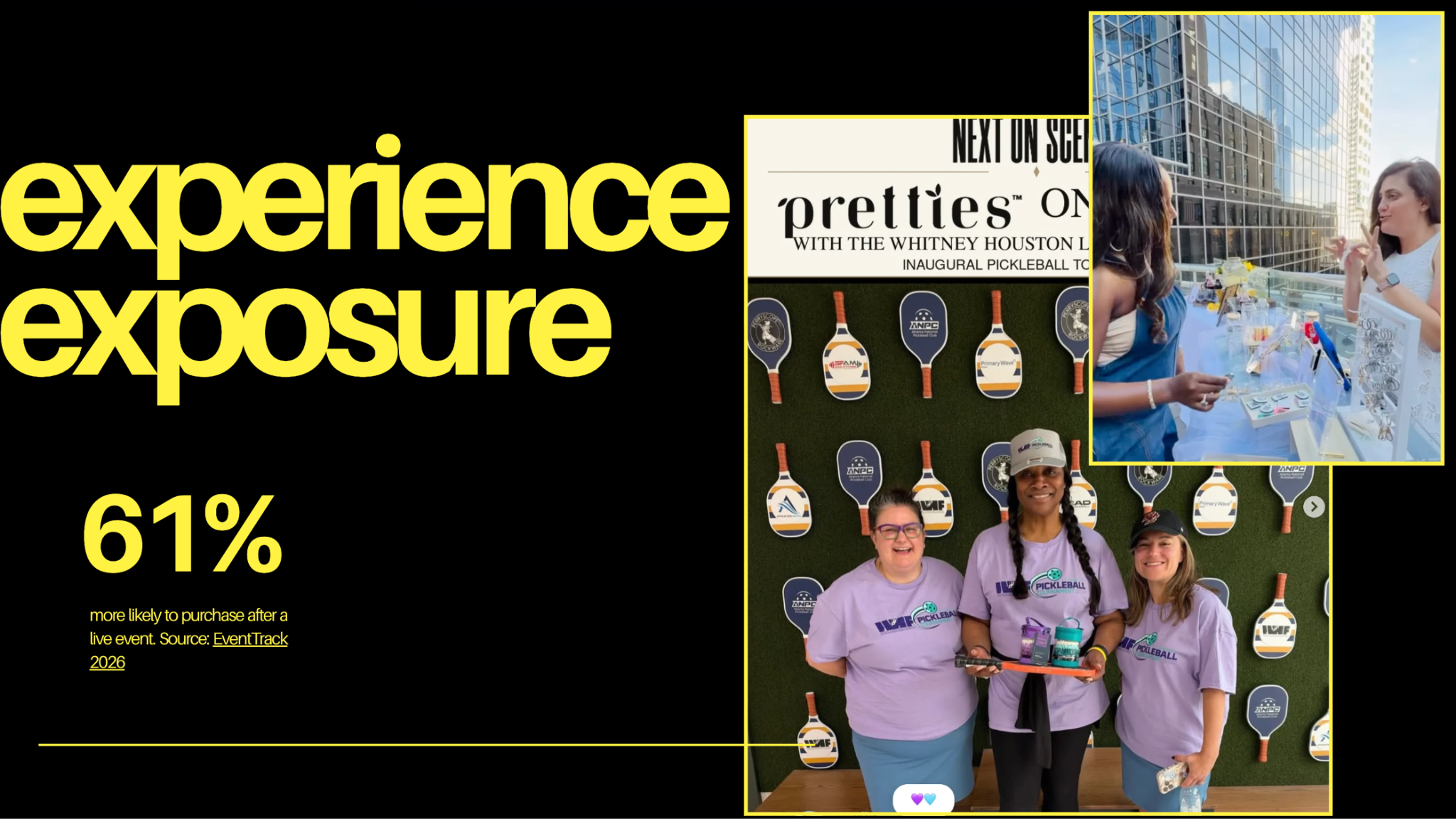
Another shift I am watching closely is the move toward experience.
At Coachella, for example, brands were not simply putting up banners and hoping people noticed them. They were creating spaces people wanted to enter, photograph, share, and remember.
The product was only part of the story while the experience became the story.
I described it this way during the session: the product is becoming the souvenir, and the brand is becoming the experience.
You do not need a Coachella budget to understand this just look at what I call puppy-dog marketing.
You can show someone a picture of a puppy and they can easily tell you they do not need one.
Put the puppy in their house, let it curl up on the couch, and let the kids play with it for an afternoon, and suddenly the decision feels different.
You have not just explained the product, you have helped them experience their life with it.
The same thing can happen with a service business.
A thoughtful onboarding process can do it, a handwritten note can do it, a small physical touchpoint from a virtual company can do it. A simple detail that makes someone feel seen can become part of the experience.
During the presentation, I mentioned how much I notice when a company takes the time to write my name on something. Somebody had to stop, notice who I was, and make that small gesture.
That matters more than we sometimes think.
Intentionality is going to matter more than activity
At one point, I joked that marketers have a habit of finding a word and beating it to death.
Authenticity had its turn for the last two year, Protein appears to be having a moment now.
I think intentionality is next but I also think there is a reason for that.
As our ability to create grows, our ability to make good choices becomes more important.
We need to pause more often and ask why.
- Why this message?
- Why this channel?
- Why this audience?
- Why now?
- What are we actually trying to accomplish?
One of the best questions in the chat asked how we should deal with the tension between speed and intentionality.
That is a real tension.
I shared an example of a company that wanted to rush a product launch because a competitor had launched first.
My response was that there is always going to be a competitor.
There is always going to be someone moving faster.
There is always going to be another trend.
That does not mean you should chase it.
I remember B2B companies telling me they needed TikTok channels because TikTok was exploding. My response was simple: if your buyer is not there, why are we doing it?
Just because everyone else is doing something does not make it right for your business.
That point clearly hit home because, a few minutes earlier, the chat was filling up with comments around being ready to drop vanity metrics, including followers, likes, and algorithm pleasing. That is intentionality in practice! It is not moving slower for the sake of moving slower but knowing why you are moving at all.
AI should make us better, not more generic
The AI conversation created some of the strongest responses of the day.
I use AI every day, and I think it is one of the most useful tools marketers have ever had.
I also think we are already seeing what happens when people use it without enough judgment.
The work starts to sound the same, the language gets predictable and the thinking gets smoothed out until it barely sounds like anyone at all.
“Do not be lazy when you use AI.”
That is really the heart of my position.
Use it, Use it aggressively where it makes sense. Let it research, organize, assist, accelerate, and help you see things you might have missed, but decide what you are not willing to hand over.
- Critical thinking should stay human.
- Empathy should stay human.
- Strategic judgment should stay rooted in the years of experience you have actually lived.
AI can support the thinking, but it should not replace the thinking.
The chat lit up around this!!
One person said she had stopped using AI to create her content because she was getting better results after returning to her own voice.
Another said, “Good thought content comes from the brain. Use AI to polish.”
Or “whatever you publish should sound like you, not AI.”
“No one wants to read what ChatGPT thinks your spicy hot take is.”
That was exactly the energy I had hoped the conversation would create.
Nobody was anti-AI we were all pro-judgment by a REAL human.
Thought leadership only works when you actually have a point of view
Companies tell me all the time that they want to be known as the leader in their industry.
My response is always the same.
- What do you believe?
- What do you disagree with?
- What have you learned?
- What do you see happening that others may not?
During the presentation, I shared research showing that B2B buyers place significant trust in thought leadership and that people are more likely to recommend brands when they follow their executives.
That does not mean your CFO needs to start dancing on TikTok.
It means your leaders need to sound like actual people who can teach, explain, disagree sometimes and share what they are seeing from their seat.
People buy into what real people have to say and do. Again, the room immediately took the idea further.
“Own your area of genius in every communication.”
“My content educates people about why imagery works and how it affects perception.”
“My thought leadership comes from 30 years of lived experience, including what happens when teams are struggling and everything goes sideways.”
“My approach is showing my proven results, storytelling, trust, and voices from C-suite clients.”
That is thought leadership. It is not broadcasting more opinions but turning experience into something useful for someone else.
We need to stop trying to be the unicorn marketer
Near the end of the conversation, Chris asked what marketers should stop chasing in 2027.
My answer was the unicorn.
The Marketing role keeps expanding and changing in real time. We can see this in the open Job Role Descriptions on Linkedin. We are expected to understand brand, content, AI, social, SEO, paid media, analytics, customer acquisition, communications, technology, demand generation, and increasingly revenue itself.
At some point, pretending one person should be exceptional at all of it becomes absurd.
I said, “Being the unicorn and knowing it all is just impossible.”
You need to know where you are exceptional and then you need enough understanding of the adjacent disciplines to ask intelligent questions.
More importantly, you need other people. That idea kept surfacing throughout the entire conversation.
People were offering examples to one another.
- They were making suggestions.
- They were sharing what they had learned.
- They were taking somebody else’s idea and making it better.
The real trend may be better conversations
While we can research predictions, ask AI to summarize them, curate new tools to test, and download endless reports, every marketing leader must ultimately make the call on what truly matters.
Eventually, though, every marketing leader has to make a decision, what deserves the budget, what your team can stop doing, whether the new platform matters and whether the idea is smart or you are simply too close to it to see the problem.
You have to decide what you are willing to hand to AI and what still needs your judgment.
Those decisions get better when you have people around you who understand the work and are willing to challenge your thinking.
That is why the energy in this session mattered so much to me.
The presentation started the conversation, but the value kept growing as people added their own experiences, questions, and perspectives.
That is what happens inside The Momentum Exchange every week.
We bring the real marketing problems onto the table, including the ones I affectionately call the dumpster fires sitting on our desks, and we work through them with people who know what it feels like to be responsible for the answer.
I do not think 2027 needs marketers doing more. I think it needs marketers who are clearer about what deserves to be done. It needs better judgment, stronger points of view, more human connection, and people who are willing to help one another see what they cannot see alone.
That is the trend I am betting on.
Do less. Mean more.